COMPARE
FlowFinds vs Shopify
Shopify is a real platform and a fine one. It is also a platform, not a product: it hands you an empty store and a theme, and everything that fills it — a product to sell, a supplier, reviews, an upsell, an ad — is yours to find and yours to pay for. FlowFinds picks the product, builds the store, and funds the first ad. Below is what that actually costs, on both sides, sourced from each company's own pages.
No card. Your product is picked for you.
What the store itself costs
| Plan | Billed monthly | Billed yearly |
|---|---|---|
| FlowFinds | $0 | $0 |
| Shopify Basic | $39 | $29 |
| Shopify Grow | $105 | $79 |
| Shopify Advanced | $399 | $299 |
| Shopify Plus | from $2,300 | no yearly discount shown |
Source: shopify.com/pricing, checked 2026-09-02. Shopify's starter tier no longer appears on its own pricing page — shopify.com/starter now redirects to a free-trial offer. Method note: this figure was cross-checked against a second render of the same page (the plan cards and the full feature-comparison table agree) because this machine's own connection resolves to a non-US region by default. Tax is not included on either side — Shopify's own terms say its fees are exclusive of sales tax.
Card fees, if you take orders
Shopify charges a processing rate on every card order, on every plan — lower if you use Shopify Payments, with a further surcharge if you don't:
| Plan | Standard card | Extra fee, not Shopify Payments |
|---|---|---|
| Basic | 2.9% + 30¢ | +2% |
| Grow | 2.7% + 30¢ | +1% |
| Advanced | 2.5% + 30¢ | +0.6% |
Source: shopify.com/pricing, checked 2026-09-02. “There are no setup fees on any of our plans” — also from Shopify's own pricing FAQ, and it is true; the cost is the plan and the processing rate, not a hidden setup charge.
What a one-product store needs beyond the plan
A store is not a business. Shopify's own theme ships empty: no supplier, no reviews, no upsell, no email flow. Every app below has a genuine free tier — the honest claim is not that Shopify forces you to pay, it is that the free tiers are capped, and a real one-product store hits those caps fast:
- Supplier / dropship — DSers, first paid tier $19.90/mo. (Zendrop's free tier links 0 products.)
- Reviews — Judge.me, $15/mo (a free “Forever Free” tier exists, feature-capped).
- Upsell at checkout — ReConvert, $4.99/mo (free tier is dev-stores only, not a live store).
- Email — Klaviyo, $20/mo above 250 contacts.
- Landing pages — PageFly, $24/mo (free tier: one page slot).
Realistic minimum to open with reviews and an upsell: about $15–$25/mo on top of the plan. With visual reviews and a page builder too, $60+/mo. FlowFinds bundles a supplier and a store built around one product with none of this shopping list — there is nothing to install before your first visitor arrives.
Source: apps.shopify.com, each app's own published pricing page, checked 2026-09-02.
The domain
Shopify does not publish a flat domain price — it varies by the extension you pick and is shown only at purchase, plus a renewal fee every year after, billed separately from the plan. FlowFinds buys the domain for you, free, as part of getting your store live; it is one of the two things the product explicitly funds.
Source: help.shopify.com, “Buying domains,” checked 2026-09-02.
Time to a live store
Shopify does not publish a time-to-live-store figure anywhere in its setup docs, and its own general checklist for “Set up your online store” is an unnumbered list of about nineteen items with no duration attached. Its help center goes further: “adding and organizing your product listings can be the most time-consuming step of setting up a Shopify store” — that step is entirely on you.
FlowFinds does not publish a stopwatch number either, and we are not going to invent one to win a comparison. What is checkable is the structure: there is no theme to choose, no product listing to write, and no app to install before your store is live — the product is matched to you and the store is generated around it in one walkthrough, not assembled step by step.
Sources: help.shopify.com/en/manual/intro-to-shopify/new-to-shopify-checklists/general-checklist and help.shopify.com/en/manual/intro-to-shopify/initial-setup, checked 2026-09-02.
What's changed on Shopify lately
Not a bad quarter — this is what a general-purpose platform at Shopify's scale looks like from a merchant's chair this year.
Two outages this summer, both caught by outsiders first. On June 3, a roughly two-hour outage hit storefronts and checkout; Shopify acknowledged it at 13:27 UTC, sixteen minutes after an independent monitor's alert had already fired. On June 24, a wider disruption reached storefronts, admin dashboards and merchant access across multiple regions; Shopify didn't acknowledge it until 11:37 UTC — after recovery had already begun, a 21-minute gap. Nothing since, as far as we found, through the day we checked.
Sources: PYMNTS, “Shopify Resolves 2-Hour Outage Impacting Storefronts and Checkouts,” and StatusGator, “Shopify Outage Affects Stores, Admin Panels, and APIs on June 3, 2026” and “June 24 Global Shopify Outage: Timeline and Impact,” all checked 2026-09-02.
Shopify Scripts is gone. Merchants used it to write live checkout logic. From Shopify's own changelog: “Editing and publishing new Shopify Scripts will no longer be possible” as of April 15, 2026, and “All Shopify Scripts will stop executing entirely” from June 30, 2026 — migrate to Shopify Functions or a public app, on Shopify's timeline.
Source: changelog.shopify.com, “Shopify Scripts deprecation: editing ends April 15, execution ends June 30, 2026,” posted 2026-03-12, checked 2026-09-02.
Checkout tracking is next. August 26, 2026 is the deadline for every remaining non-Plus store's legacy checkout customizations — the box merchants had pasted ad-tracking code into for years. After that date the upgrade is mandatory and irreversible for whatever hasn't migrated. We are sourcing this to independent reporting, not to Shopify's own words directly: that reporting cites Shopify's documentation, but we did not confirm the deprecation notice on a first-party Shopify page ourselves.
Source: digitalapplied.com, “Shopify Checkout Deadline: 12 Days to Migrate,” published 2026-08-14, checked 2026-09-02. Third-party, citing Shopify's docs — not a first-party quote.
Shopify's own fulfillment arm raised its minimum fee tenfold. A merchant on Shopify's own community forum: “Flexport, the logistics arm of Shopify Fulfilment Network will be charging $5000 per month regardless of whether you have used that much value from their fulfilment network… a 10X(!!!) increase in 6 months time.” The post is from August 2025 — over a year old — but the $5,000 minimum is the live 2026 rate, and merchants were still discussing it as recently as June 24, 2026.
Source: community.shopify.com, Flexport/SFN fee thread (“Neale_Kelly”), original post 2025-08-05, checked 2026-09-02.
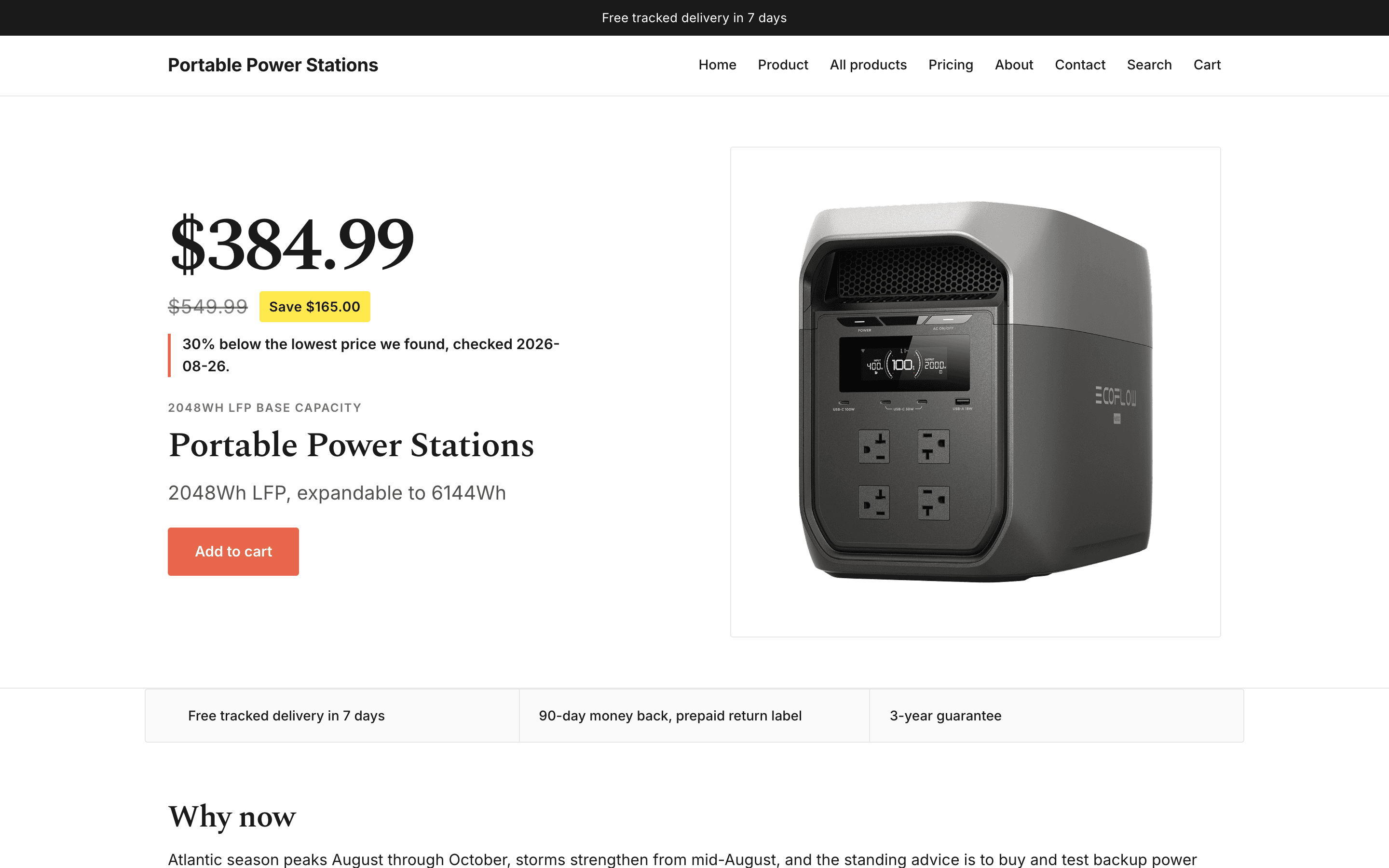
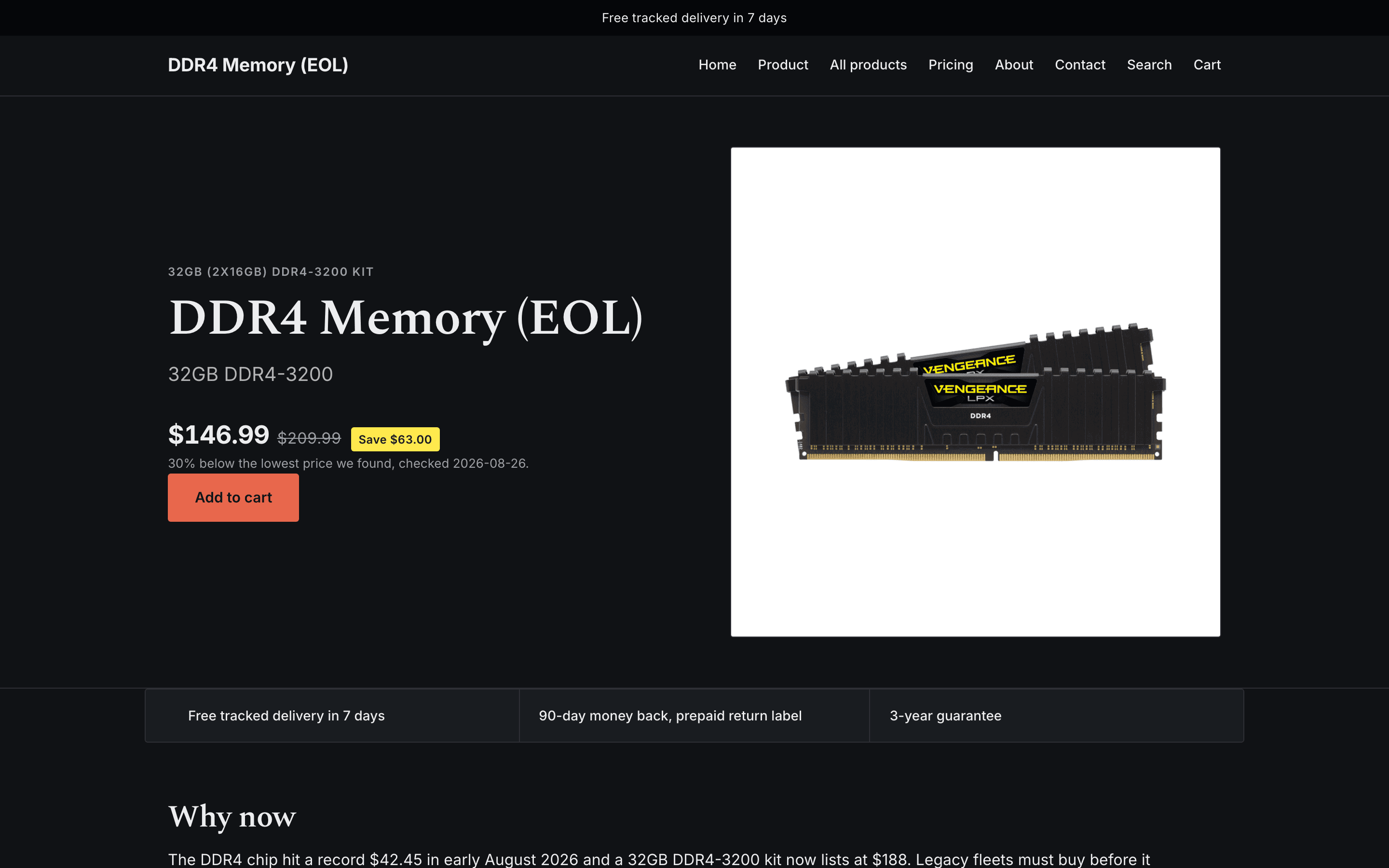
What a real, generated FlowFinds store looks like
Not a screenshot from a deck — a live store, reachable right now, built for a real product with a real product photo. Two of them, so you can see they don't share a template:
After the sale
A store that only takes the order is half a business. What a FlowFinds store does once a customer pays, built and checked on 2026-09-08 (the first pilot store opens card payments; until then every store is in sandbox and says so on its checkout page):
- Checkout with a delivery address, hosted card payment, and a receipt from your store's own address.
- Orders go to your supplier: your own supplier gets the order sheet by email, or a connected catalog supplier gets it automatically and reports tracking back.
- The buyer is told when it is confirmed, sent, in transit and delivered, and can look it up on your store's tracking page.
- Refunds go back to the card through the payment provider first, then to the ledger, never the other way round.
- Payouts land weekly in your bank account, net of refunds and the plan fee, with a statement.
- Profit and loss per store, a CSV your accountant can open, and one daily email listing what needs you.
- Support answers a customer's “where is my order” from the order itself, and the store's contact form lands in your inbox.
Where Shopify beats us — honestly
A comparison nobody believes converts nobody, and we are three accounts old. Here is where the gap is real, not softened:
- Payments infrastructure. Shopify Payments, fraud protection, 3D Secure, chargeback handling, multi-currency payouts — a decade of built plumbing. We have hosted card checkout, refunds and weekly payouts in one currency per store; fraud tooling and chargeback handling are the provider's and ours by hand.
- An app ecosystem. Whatever it costs, it exists — thousands of apps solving nearly any problem a merchant hits. We have no third-party ecosystem; if we haven't built it, there is nowhere else to go.
- Scale and trust. Millions of live merchants, and by Shopify's own count, “every 26 seconds, an entrepreneur makes their first sale on Shopify.” A brand-new platform cannot match that honestly, and we are not going to fake it.
- Multi-channel selling. Point of sale, Instagram and TikTok shops, Amazon, wholesale — all live, all mature. FlowFinds is one channel, the generated store, today.
- Human support at any hour. However slow or inconsistent people say it is, it exists at a scale ours does not yet.
We are not pretending these gaps are not real. Shopify is a mature, general-purpose, expensive platform, built for someone who already has a product, a supplier and a brand. FlowFinds is fast, free to start, and does one job — find the product, build the store, fund the first ad — with no app tax. Judge us on that, not on years of features we have not built yet.
Source for the 26-seconds figure: shopify.com/pricing, checked 2026-09-02.